 Keeping your boat shipshape!
Checklists · AftLog Blog
Keeping your boat shipshape!
Checklists · AftLog Blog
Used-Boat Inspection Checklist
Buying a used boat can save thousands — but only if you know what to look for. Here's the complete inspection checklist, based on AftLog's built-in Used-Boat template.
Buying a used boat can be one of the smartest decisions a boater makes. You can save thousands of dollars, avoid steep depreciation, and often get a well-maintained vessel that performs like new. But used boats vary widely in condition, and a poor inspection can turn a great deal into an expensive mistake.
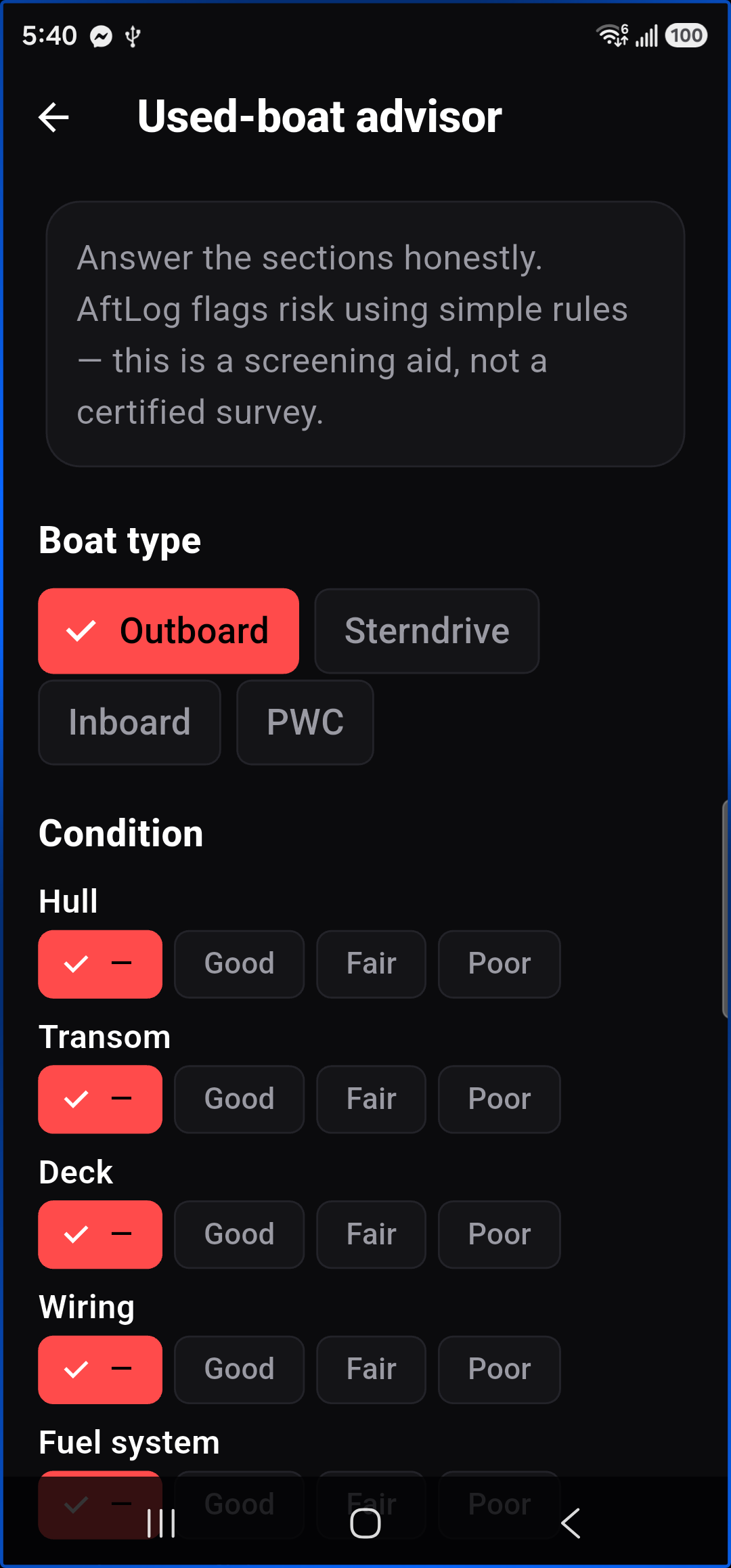
AftLog includes a dedicated Used-Boat Inspection checklist — a structured, big-button guide that walks you through every major system: hull, transom, engine, electrical, fuel, bilge, trailer, and safety gear. This article expands on that checklist, explaining exactly what to look for and how to evaluate a boat before you buy.
Why Used-Boat Inspections Matter
A boat is a collection of systems — hull, transom, engine, lower unit, steering, electrical, fuel, bilge, and trailer. If any is compromised, repairs can be costly. A cracked transom, damaged lower unit, or neglected electrical system can turn a $10,000 boat into a $15,000 project. A structured inspection prevents surprises and gives you confidence in your purchase.
Part 1 — Hull Condition
Check for cracks and stress marks around the bow, near the transom, around cleats and the windshield, and along the chines (hairline cracks are common; deep cracks are not). Check the gelcoat for oxidation, chalkiness, blistering, or repairs. Inspect the underside for gouges, beaching scars, impact marks, or exposed fiberglass. Tap the hull lightly — dull thuds can indicate moisture (water intrusion).
Part 2 — Transom Condition
The transom supports the engine — a weak transom is a deal-breaker. Check for cracks around the mounting bolts, flexing when you push the engine, water intrusion, soft spots, and delamination. Test by grabbing the engine and pushing side-to-side; if the transom flexes, walk away.
Part 3 — Prop & Lower Unit
The lower unit is expensive to repair, so inspect carefully. Check the prop for bent blades, chips, cracks, or fishing line around the shaft (line can cut seals and cause water intrusion). Ask to see the gear oil — healthy oil is clear, amber, and free of metal; milky oil means water intrusion and an expensive repair. Check the skeg for cracks, missing chunks, or welded repairs, and confirm the engine shifts smoothly into forward and reverse.
Part 4 — Steering & Controls
Check the steering for stiffness, binding, uneven resistance, or hydraulic leaks. Check the controls for smooth throttle, smooth shifting, proper idle, and no grinding noises.
Part 5 — Electrical System
Electrical issues are common in used boats. Test the lights, horn, bilge pump, livewell pump, GPS/fish finder, radio, gauges, and ignition. Inspect the wiring for condition, corrosion, and loose connections, plus the battery cables.
Part 6 — Battery Health
Check the battery age, resting voltage (12.6–12.8V), terminal corrosion, and secure mounting. Weak batteries cause hard starting and electrical issues.
Part 7 — Fuel System
Inspect the fuel lines for cracks, stiffness, or leaks; check the primer bulb, tank vent, and fuel filter (for water or debris), and smell for fuel in the compartments. Ask when the fuel filter was last changed and whether the boat has had ethanol-related issues.
Part 8 — Bilge & Pumps
Check the bilge pump operation, float switch, livewell pumps, hoses, and clamps, and look for signs of water intrusion. A wet bilge can indicate leaks or hull issues.
Part 9 — Trailer Condition
The trailer is half the value of the package. Inspect the tires (age, cracks, pressure), bearings (heat after towing), lights, winch strap, bunks and carpet, rust, and frame integrity. Test by spinning each wheel — grinding indicates bad bearings.
Part 10 — Safety Gear
Check for life jackets, throwables, a fire extinguisher, a whistle/horn, anchor and rope, a first-aid kit, and navigation lights. Missing safety gear adds cost.
Part 11 — Engine Start & Water Test
If possible, always test the engine on the water. Check cold-start behavior, tell-tale strength, idle stability, acceleration, top-end RPM, vibration, shifting, temperature, and charging voltage. A water test reveals issues a driveway start cannot.
Part 12 — Paperwork & History
Ask for service records, winterization receipts, ownership documents, the engine serial number, and trailer registration. A well-documented boat is a well-maintained boat.
How AftLog Helps
AftLog's Used-Boat Inspection checklist provides big-button, tap-friendly items, a structured inspection flow, photo attachments for each item, notes for seller comments, a final summary card, and exportable results — a professional-grade inspection process.
Checklist: Used-Boat Inspection (AftLog Preset)
- Hull condition
- Transom condition
- Prop & lower unit
- Steering & controls
- Electrical system
- Battery health
- Fuel system
- Bilge & pumps
- Trailer condition
- Safety gear
Summary
Buying a used boat is a smart move — but only if you inspect it properly. By following AftLog's Used-Boat Inspection checklist, you can evaluate every major system, spot hidden issues, and make a confident, informed purchase. A structured inspection protects your wallet and ensures your new boat is safe, reliable, and ready for the water.
Track these on your boat with AftLog — free to start, $29 lifetime Pro.