
 Keeping your boat shipshape!
Safety · AftLog Blog
Keeping your boat shipshape!
Safety · AftLog Blog
How to Handle an Engine That Won't Start
Few moments in boating are more frustrating than an engine that won't start. Here's the calm, step-by-step process every boater should follow to diagnose the problem and get back underway safely.
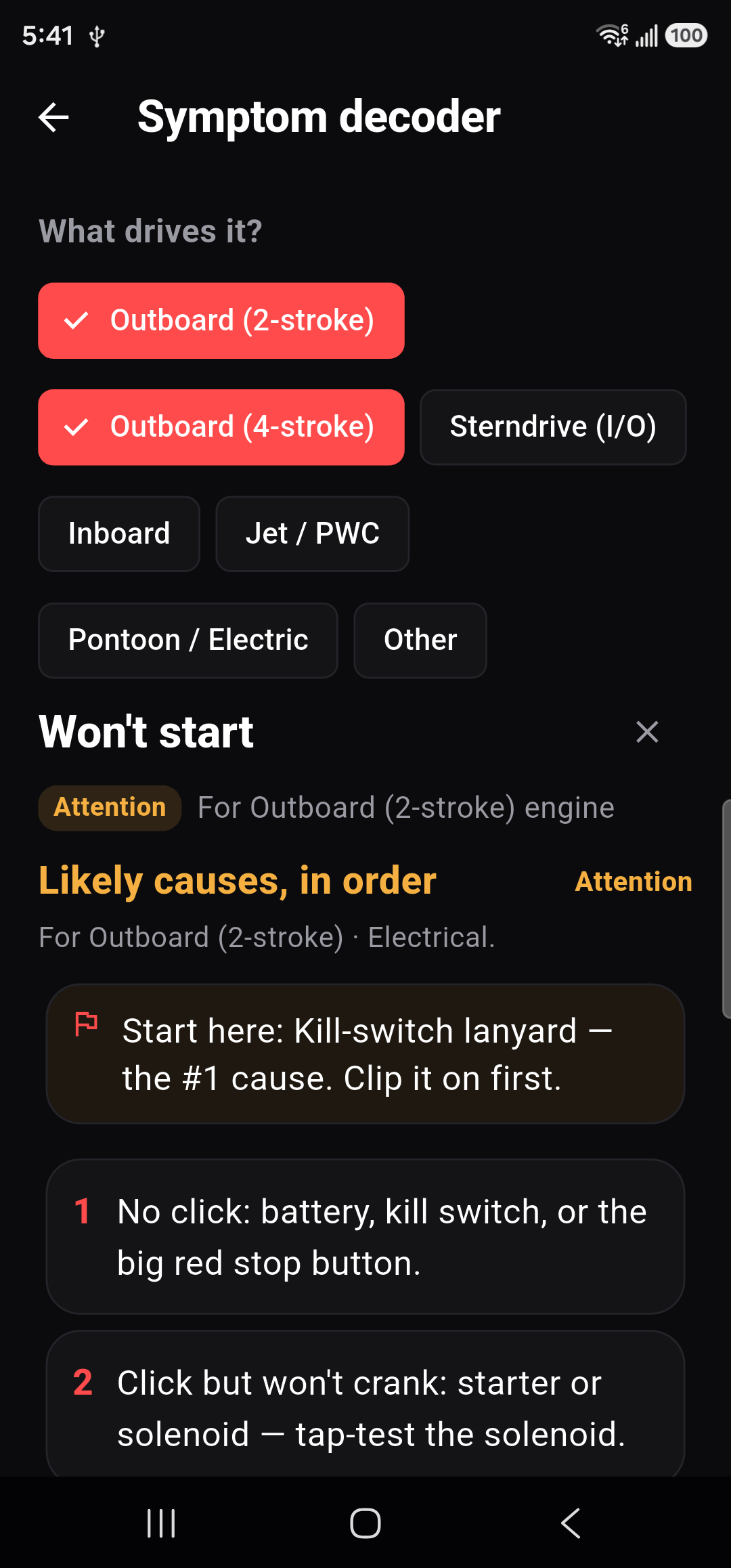
Few moments in boating are more stressful than turning the key — or pressing the start button — and hearing nothing. No crank. No click. No ignition. Just silence. Whether you're at the dock, at the ramp, or drifting offshore, an engine that won't start can turn a great day into a tense one.
The good news is that most “won't start” situations are caused by simple, fixable issues. With a calm, methodical approach, you can diagnose the problem quickly and often get the engine running again without tools or technical knowledge.
Stay Calm and Think Systematically
When an engine won't start, panic is your enemy. Outboards are simple machines. They need only three things to start: spark, fuel, and air — plus, rarely, compression. And before any of that, they need electrical power and the safety interlocks satisfied.
Most starting failures fall into one of these categories: battery or electrical issue, kill-switch or safety interlock, fuel delivery problem, flooding, vapor lock, starter motor or solenoid issue, or an ignition-system fault.
Step 1 — Check the Kill-Switch (Most Common Cause)
The kill-switch lanyard is responsible for more “won't start” situations than any other single cause. Make sure the lanyard is clipped in properly — even a slightly loose clip prevents starting. Check for hidden kill-switches: some boats have a helm kill-switch, stern kill-switch, wireless fob kill-switch, or neutral-safety interlock. If any are tripped, the engine will not crank. Typical symptoms are no crank, no click, gauges may still power on, and the starter does nothing. If the kill-switch is the problem, fixing it often restores immediate starting.
Step 2 — Check Battery Power
If the kill-switch is fine, the next most common issue is battery power. Turn on accessories — do the lights, horn, or electronics work? If everything is dead, the battery is fully discharged or disconnected. If accessories work but the engine won't crank, the battery may be weak, corroded, poorly connected, or unable to supply starter current. Check the terminals for corrosion, loose clamps, broken wires, or frayed cables. Tighten terminals firmly; corrosion can be cleaned with a knife, key, or even a coin in an emergency. If the engine cranks now, the issue was a loose or corroded connection.
Step 3 — Check the Gear Selector
Outboards will not start unless the gear selector is in neutral. Move the shifter firmly into neutral — sometimes the detent is soft or misaligned. Try wiggling slightly while starting. Symptoms of a neutral-safety issue are no crank, no click, working gauges, and a fine battery. If the engine starts after adjusting the shifter, the neutral-safety switch was the culprit.
Step 4 — Check the Fuel System
If the engine cranks but won't start, the issue is usually fuel: check the fuel level; check the fuel line for kinks, disconnected fittings, or a collapsed hose; and check the primer bulb — it should be firm when squeezed (if soft, squeeze until firm, listen for fuel entering the engine, and check for air leaks at fittings). Check the tank vent — a closed vent causes vacuum lock (symptoms: engine starts then dies, bulb collapses, fuel flow stops). And check the fuel filter — if you have a clear bowl, look for water, debris, or phase-separated ethanol.
Step 5 — Check for Flooding
Flooding happens when too much fuel enters the cylinders. Symptoms include a strong fuel smell, the engine cranking but not firing, sputtering, and wet spark plugs. To clear flooding: open the throttle fully (fast idle lever or throttle-only mode), crank for 5–10 seconds, release the throttle, then try starting normally.
Step 6 — Check for Vapor Lock (Hot Restart Problems)
Vapor lock occurs when fuel vaporizes in the lines on hot days: the engine ran fine earlier, won't restart after sitting hot, the bulb is soft, and it sputters but won't fire. Fix: squeeze the primer bulb until firm, open the tank vent, wait 2–3 minutes, and try starting again.
Step 7 — Check the Starter Motor and Solenoid
If you hear a click, repeated clicking, or slow cranking, the starter or solenoid may be the issue. Try tapping the starter lightly (sometimes brushes stick), check battery voltage again (low voltage causes slow cranking), and check the main fuse — a blown fuse can prevent starter engagement.
Step 8 — Check Spark
If the engine cranks but won't fire, spark may be the issue — symptoms are normal cranking, no ignition, no sputter, and no attempt to fire. Possible causes are fouled spark plugs, a failed ignition coil, water intrusion, or damaged plug wires. Removing and inspecting one plug can reveal the issue.
Step 9 — If You're on the Water
- Drop anchor if possible — prevents drifting into hazards.
- Turn on your radio — monitor channel 16.
- Notify someone if needed — a simple “engine trouble, anchored, troubleshooting” message is enough.
- Keep calm — most issues are fixable.
Step 10 — When to Call for Help
Call for assistance if you smell burning, the engine overheated, you struck something, the starter smokes, the battery is completely dead, fuel is leaking, you're drifting into danger, or the weather is worsening. Safety first — engines can be repaired, people cannot.
How AftLog Helps
AftLog's diagnostic tools help you identify symptoms, follow step-by-step troubleshooting, log engine behavior, track battery health, track fuel-system maintenance, store photos of plugs, filters, and terminals, and know when professional service is needed.
Checklist: Engine Won't Start
- Check the kill-switch
- Check battery power
- Check the terminals
- Check the gear selector
- Check fuel level
- Check the primer bulb
- Check the tank vent
- Check for flooding
- Check for vapor lock
- Check the spark plugs
- Check the starter motor
- Anchor if drifting
- Call for help if unsafe
Summary
An engine that won't start is frustrating, but rarely catastrophic. With a calm, systematic approach, you can diagnose most issues quickly and often get back underway without tools. By understanding the common causes — kill-switch, battery, fuel, flooding, vapor lock — you'll be prepared for the moment every boater eventually faces.
AftLog guides you through the process step-by-step, so you're never alone when your engine refuses to start.
Track these on your boat with AftLog — free to start, $29 lifetime Pro.