
 Keeping your boat shipshape!
Safety · AftLog Blog
Keeping your boat shipshape!
Safety · AftLog Blog
Overheating on the Water: What to Do
When your outboard overheats, every second counts. Here's how to respond calmly, diagnose the cause, protect your engine, and get back underway safely.
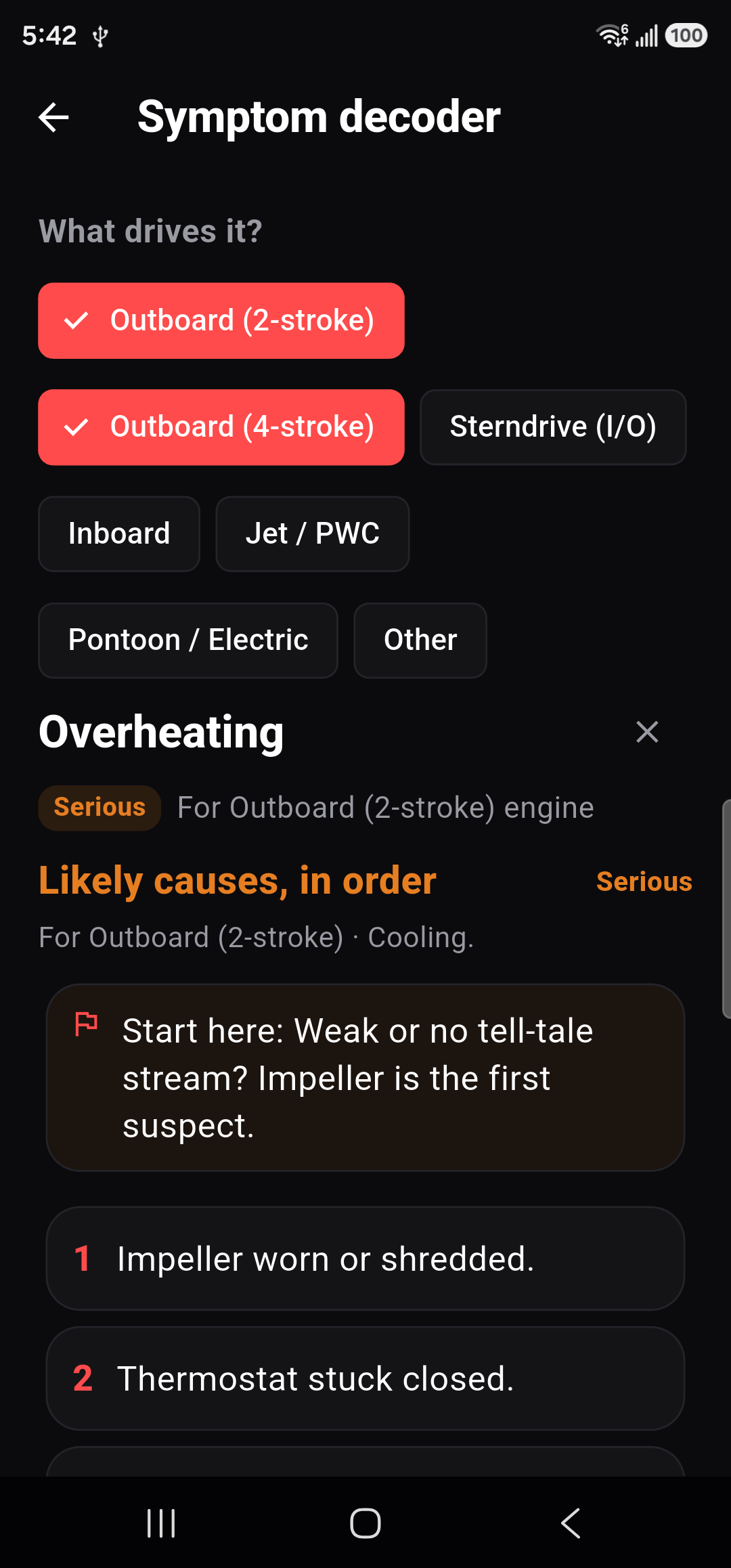
An overheating outboard is one of the most urgent problems a boater can face. When the temperature alarm sounds or the tell-tale stream weakens, you have only minutes to act before serious damage occurs. Overheating can warp heads, melt pistons, destroy thermostats, and cause thousands of dollars in repairs.
The good news is that most overheating events are caused by simple, fixable issues — and if you respond quickly and calmly, you can often resolve the problem on the water and prevent long-term damage. This guide explains what to do when your outboard overheats, the most common causes, how to diagnose the issue, and how to prevent overheating in the future.
Recognizing Overheating Symptoms
- Temperature alarm — a loud, continuous beep or tone; the most reliable warning.
- Reduced power / limp mode — the engine automatically reduces RPM to protect itself.
- Weak or no tell-tale stream — cooling water flow is reduced or missing.
- Steam from the tell-tale — indicates hot water and restricted flow.
- Hot engine cover — if the cowling feels unusually hot, shut down immediately.
- Rough idle or stalling — overheating can affect combustion.
If you notice any of these signs, act immediately.
Step 1 — Shut Down the Engine Immediately
Continuing to run an overheating engine can cause catastrophic damage. Turn off the engine as soon as the alarm sounds — do not try to “limp back” unless you are in immediate danger. Drop anchor if drifting to prevent drifting into hazards while you troubleshoot.
Step 2 — Check the Tell-Tale Stream
The tell-tale is your window into the cooling system. A strong stream means the issue may be internal (thermostat, sensor, blockage). A weak or sputtering stream likely means impeller wear or partial blockage. No stream means cooling water is not reaching the engine — shut down immediately. Steam means water is entering but not circulating properly.
Step 3 — Inspect the Water Intake
Most overheating events are caused by blocked intakes. Check for weeds, mud, sand, plastic bags, fishing line, or debris. Clear the intake manually — with a stick, knife, or your hand (carefully). Restart briefly to check the tell-tale; if the stream returns strong, the blockage was the cause.
Step 4 — Squeeze the Primer Bulb
A soft primer bulb can indicate fuel vapor lock or air in the line, which can indirectly cause overheating by reducing engine RPM and water-pump speed. If the bulb is soft, squeeze until firm, check for leaks, and restart while monitoring the tell-tale.
Step 5 — Check for Shallow Water or Sand Ingestion
Running in shallow water can suck sand into the cooling system — symptoms are a weak tell-tale, sputtering flow, overheating at idle, and debris in the stream. If you suspect sand ingestion: shut down, tilt the engine up, inspect the intakes, and restart briefly to flush. If the tell-tale stays weak, the impeller may be damaged.
Step 6 — Check the Impeller
The impeller is the heart of the cooling system — if it fails, overheating is inevitable. Symptoms of impeller failure are a weak or no tell-tale, overheating at low RPM, steam, and recent sandy or weedy conditions. If the impeller is the cause, you cannot fix it on the water — return to shore at idle or be towed.
Step 7 — Check the Thermostat
Thermostats regulate engine temperature. If one sticks closed, overheating occurs quickly. Symptoms are a strong tell-tale, overheating at mid-range RPM, normal idle temperature, and a sudden alarm after acceleration. Thermostat issues require service but are not usually catastrophic if caught early.
Step 8 — Check for Internal Blockages
Salt, scale, or debris can clog cooling passages. Symptoms are a strong tell-tale, persistent overheating, steam, and inconsistent temperature. This requires professional flushing.
Step 9 — Let the Engine Cool
- After shutting down, wait 10–15 minutes and let the engine cool naturally.
- Do not pour cold water on the engine — rapid cooling can crack components.
- Restart briefly to test — if the tell-tale is strong and the alarm stays off, you may continue at reduced speed.
Step 10 — Return to Shore Safely
If the engine continues to overheat: idle back slowly (low RPM reduces heat load), avoid planing (high RPM increases cooling demand), and if overheating persists at idle, shut down and call for assistance.
Common Causes of Overheating
- Blocked water intake — weeds, mud, sand, debris
- Worn impeller — most common cause of persistent overheating
- Thermostat failure — stuck closed or clogged
- Sand ingestion — clogs passages and damages the impeller
- High RPM in hot weather — cooling demand exceeds supply
- Low engine RPM due to fuel issues — weak cooling flow
- Internal blockage — salt, scale, corrosion
- Sensor failure — false alarms (rare)
How to Prevent Overheating
- Replace the impeller every 2–3 years — more often in sandy or shallow water
- Avoid running in very shallow water
- Inspect intakes regularly — especially after beaching or weed beds
- Keep the tell-tale clean — salt can clog the outlet
- Flush the engine after saltwater use
- Replace the thermostat every 3–5 years
- Maintain the fuel system — weak RPM reduces cooling flow
- Log overheating events in AftLog
How AftLog Helps
AftLog automatically tracks impeller intervals, logs overheating events, stores photos of tell-tale flow, notes symptoms of cooling issues, reminds you when service is due, provides step-by-step diagnostics, helps identify intake blockages, and tracks thermostat replacement intervals.
Checklist: Overheating Response
- Shut down immediately
- Drop anchor
- Check the tell-tale
- Inspect the water intake
- Clear debris
- Squeeze the primer bulb
- Check for sand ingestion
- Let the engine cool
- Restart briefly
- Idle back if safe
- Call for help if overheating persists
- Log the event in AftLog
Summary
Overheating is one of the most urgent problems an outboard can face, but most causes are simple and fixable. By responding quickly — shutting down, checking the tell-tale, clearing the intake, and inspecting the impeller — you can often resolve the issue on the water and prevent long-term damage. With proper maintenance and awareness, overheating becomes a rare event.
AftLog guides you through the process step-by-step, so you're never alone when temperatures rise.
Track these on your boat with AftLog — free to start, $29 lifetime Pro.