
 Keeping your boat shipshape!
Seasonal Prep · AftLog Blog
Keeping your boat shipshape!
Seasonal Prep · AftLog Blog
Fall Haul-Out Checklist
Fall haul-out is the most important maintenance moment of the year. Here's the complete checklist for winterizing your boat, protecting your engine, and storing everything safely until spring.
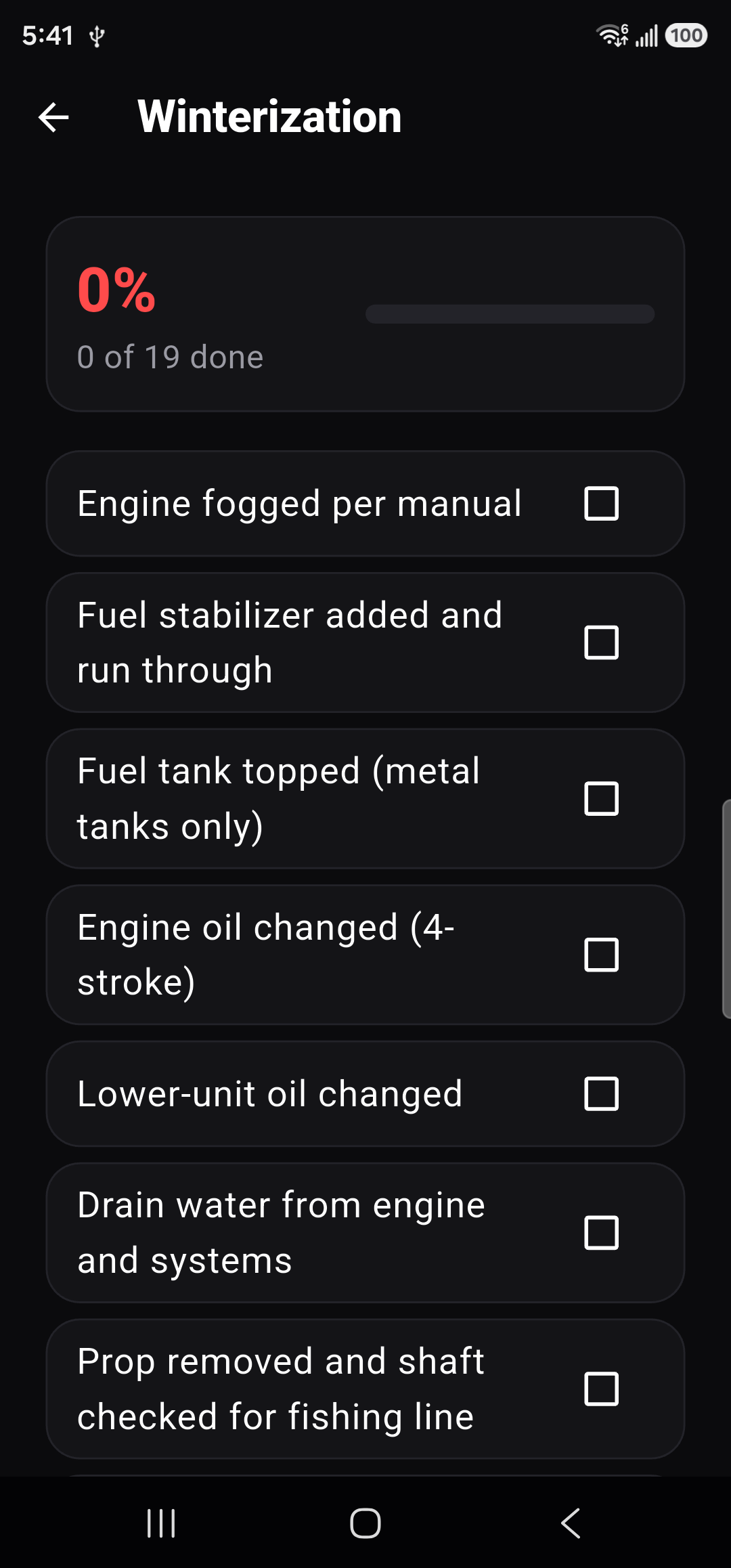
Fall haul-out is the single most important maintenance moment of the year. Winter is hard on boats — freezing temperatures, moisture, fuel degradation, and long periods of inactivity can damage engines, batteries, and hull components. A proper haul-out protects your investment and ensures your boat is ready for a trouble-free spring.
AftLog includes seasonal reminders, maintenance intervals, and structured checklists that make fall haul-out predictable and stress-free. This guide expands on those tools, giving you a complete, step-by-step process to prepare your boat for winter.
Why Fall Haul-Out Matters
Winter can damage engines, lower units, cooling systems, batteries, fuel systems, electrical connections, the hull and transom, and trailer components. A structured haul-out prevents freeze damage, corrosion, fuel separation, battery failure, lower-unit water intrusion, mold and mildew, and rodent damage. Fall is your chance to reset the boat, protect every system, and start next season fresh.
Part 1 — Final Fall Trip and Ramp Retrieval
Before winterization, take a final trip to burn off old fuel, listen for unusual noises, check tell-tale strength, verify charging voltage, and note any issues for spring service. Then retrieve using AftLog's Retrieve Mode — bow line tied, fenders on, key out, kill-switch lanyard off, battery switch off, drain plug out, straps on, winch hooked, back it out slowly.
Part 2 — Drain Water and Moisture
- Remove the drain plug — let the hull drain completely.
- Tilt the engine down — drains the cooling passages, lower unit, and exhaust housing.
- Drain livewells and bait tanks — remove plugs and let them dry.
- Drain the bilge — use the bilge pump if needed.
- Remove wet gear — coolers, ropes, anchors, and life jackets should dry before storage.
Part 3 — Engine Winterization
- Stabilize the fuel — add marine fuel stabilizer and run for 5–10 minutes to circulate it.
- Fog the engine (two-stroke and some four-stroke) — fogging oil protects internal components from corrosion.
- Change engine oil (four-stroke) — fall is best: contaminants removed, fresh oil sits all winter, moisture minimized.
- Replace the oil filter — always with the oil.
- Change lower-unit gear oil — look for milky oil, metal flakes, or a burnt smell; changing in fall prevents freeze damage.
- Inspect the prop — bent blades, chips, or fishing line around the shaft (remove line — it cuts seals).
- Grease all fittings — steering pivot, tilt tube, prop shaft, throttle linkage.
- Check the thermostat — replace every 3–5 years.
- Inspect the impeller — replace if it's been 2–3 years.
Part 4 — Fuel System Protection
Add fuel stabilizer (prevents ethanol separation), top up the tank (a full tank reduces condensation), inspect fuel lines for cracks or stiffness, replace the fuel filter (fall is the best time), and check the primer bulb (should be firm).
Part 5 — Battery Storage
Most battery failures happen during winter. Fully charge the battery with a smart charger, disconnect the terminals to prevent parasitic drain, remove the battery and store indoors if possible, use a smart maintainer, and check voltage monthly (healthy resting is 12.6–12.8V).
Part 6 — Electrical System
Inspect wiring for cracked insulation, rodent damage, or corrosion; test electronics (GPS, fish finder, radio, lights); and remove sensitive electronics to store indoors.
Part 7 — Interior and Hull Protection
Clean the interior to remove dirt, moisture, and debris; remove food and scented items to prevent rodent attraction; inspect the hull for cracks or damage; wash and wax the hull (wax protects gelcoat during winter); and dry all compartments to prevent mold.
Part 8 — Trailer Inspection
Inspect the tires for cracks and proper pressure, grease the bearings, inspect the lights (wiring and bulbs), inspect the winch strap (replace if frayed), inspect the bunks (carpet and wood), and inspect the safety chains to ensure they're secure.
Part 9 — Covering and Storage
- Use a proper boat cover — avoid cheap tarps that trap moisture.
- Support the cover — prevent pooling.
- Ventilate — moisture causes mold.
- Store indoors if possible — best protection.
- If storing outdoors — use shrink-wrap or a high-quality cover.
How AftLog Helps
AftLog provides seasonal reminders, maintenance intervals, haul-out checklists, battery-care guidance, engine-service tracking, photo logs, and safety-gear checklists — so fall haul-out becomes structured, predictable, and stress-free.
Summary
Fall haul-out is the foundation of a safe, reliable spring launch. By winterizing your engine, stabilizing fuel, draining water, protecting your battery, inspecting your trailer, and covering your boat properly, you prevent freeze damage, corrosion, and costly repairs. A well-prepared boat sleeps safely all winter — and wakes up ready for spring.
Track these on your boat with AftLog — free to start, $29 lifetime Pro.