
 Keeping your boat shipshape!
Seasonal Prep · AftLog Blog
Keeping your boat shipshape!
Seasonal Prep · AftLog Blog
Spring Prep: Getting Your Boat Ready
Spring is the most important maintenance moment of the year. Here's the complete guide to de-winterizing your boat, inspecting critical systems, and getting ready for a safe first launch.
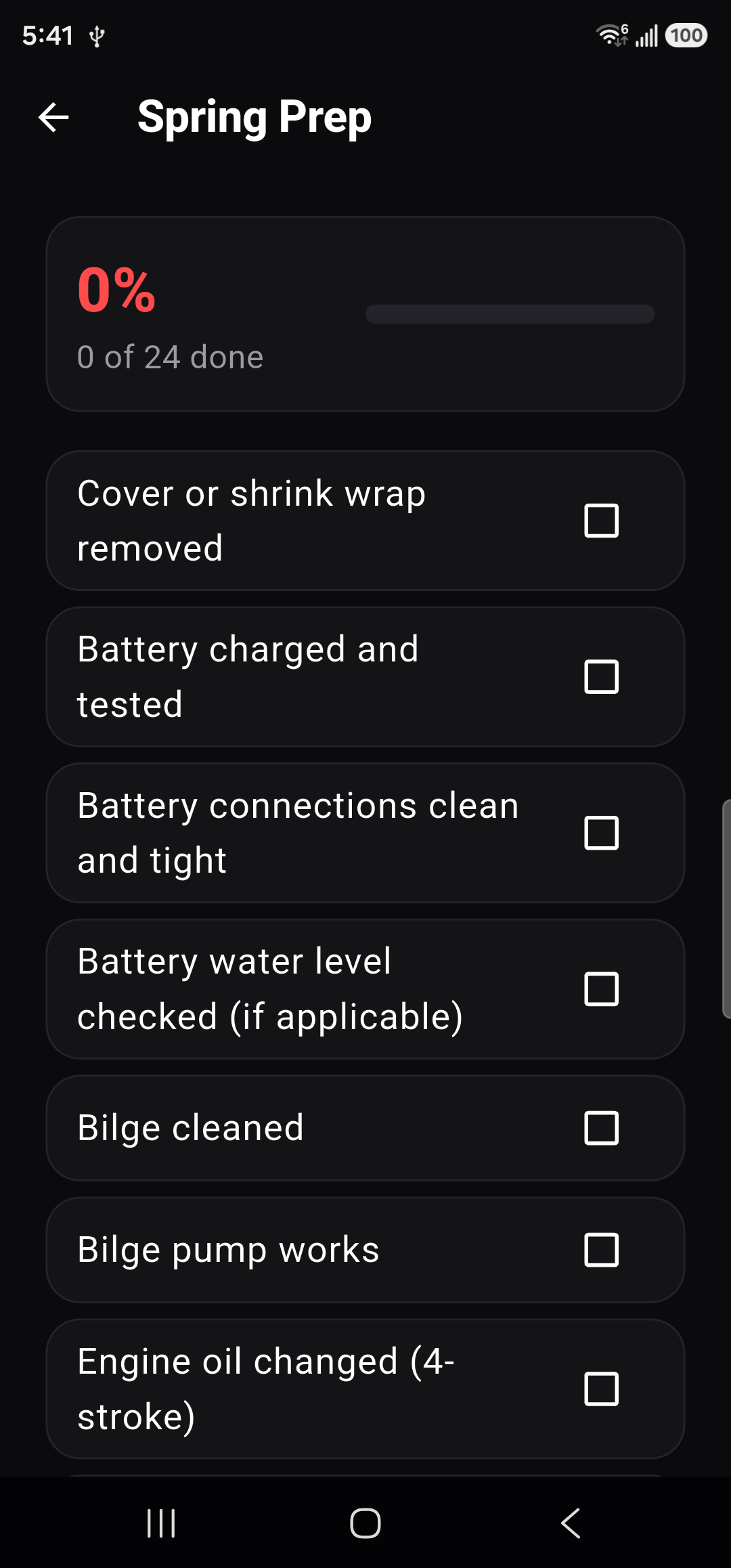
Spring is the most important maintenance moment of the year for any boat owner. After months of storage, your boat needs a careful, structured de-winterization process to ensure everything is safe, reliable, and ready for the season. A smooth spring prep prevents breakdowns, protects your engine, and sets the tone for a trouble-free summer.
AftLog includes seasonal reminders, maintenance intervals, and checklists that make spring prep predictable and easy. This guide expands on those tools, giving you a complete, step-by-step process to get your boat ready for the water.
Why Spring Prep Matters
Winter is hard on boats. Long periods of inactivity, cold temperatures, moisture, and fuel degradation can affect batteries, fuel systems, cooling systems, electrical connections, lower-unit seals, safety gear, and trailer components. Spring prep ensures every system is inspected, tested, and ready for the season.
Part 1 — Remove Winter Covers and Inspect the Boat
- Remove tarps, shrink-wrap, or covers — check for mold, moisture, rodent damage, torn insulation, or missing hardware.
- Inspect the hull — cracks, blisters, scratches, gelcoat damage, signs of impact.
- Inspect the transom — cracks around mounting bolts, flexing, water intrusion, soft spots.
- Inspect the interior — mildew, water pooling, damaged upholstery, loose hardware.
Spring is the best time to catch small issues before they become big ones.
Part 2 — Battery and Electrical System
Winter is tough on batteries — most failures happen during storage. Charge the battery fully with a smart charger, check voltage (healthy resting is 12.6–12.8V), inspect terminals for corrosion, loose clamps, or frayed cables, test the lights, horn, bilge pump, livewell pump, GPS/fish finder, radio, and gauges, and inspect wiring for cracked insulation, rodent damage, or loose connectors. AftLog's battery-care reminders help track battery age and condition.
Part 3 — Fuel System
Fuel can degrade over winter, especially ethanol blends. Inspect fuel lines for cracks, stiffness, leaks, or soft spots; check the primer bulb (should be firm); inspect the fuel filter for water, debris, or phase-separated ethanol (replace if needed); check the tank vent is clear; top up with fresh gasoline to dilute old fuel; and add stabilizer if the fuel sat all winter.
Part 4 — Engine and Lower Unit
- Change the engine oil (four-stroke) — if you didn't in the fall.
- Replace the oil filter — always with the oil.
- Change lower-unit gear oil — look for milky oil, metal flakes, or a burnt smell.
- Inspect the prop — bent blades, chips, or fishing line around the shaft.
- Inspect the impeller — replace if it's been 2–3 years.
- Inspect spark plugs — replace if fouled, worn, corroded, or the gap widened.
- Check the tell-tale — start on muffs and verify strong water flow.
AftLog tracks all these intervals automatically.
Part 5 — Cooling System
Check the tell-tale stream (strong and steady), inspect the water intakes for sand, weeds, or debris, replace the impeller if due (spring is the best time), and inspect the thermostat (replace every 3–5 years).
Part 6 — Steering and Controls
Check the steering for stiffness, binding, uneven resistance, or hydraulic leaks; check throttle and shift are smooth and responsive; and lubricate pivot points with marine grease.
Part 7 — Bilge and Pumps
Test the bilge pump, test the float switch by lifting it manually, inspect hoses for cracks or loose clamps, and check for water — a wet bilge may indicate leaks.
Part 8 — Trailer Inspection
Your trailer is half the value of your boat. Inspect the tires for cracks, bulges, or low pressure; inspect bearings (spin the wheels — grinding indicates bad bearings); test the lights; inspect the winch strap (replace if frayed); inspect the bunks (carpet and wood); and inspect the safety chains (secure, not rusted).
Part 9 — Safety Gear
Spring is the perfect time to refresh safety gear — check life jackets, throwables, a fire extinguisher, a whistle/horn, anchor and rope, a first-aid kit, navigation lights, spare fuses, and spare prop hardware. Replace anything worn or expired.
Part 10 — First Launch Checklist
- Drain plug in
- Battery switch on
- Kill-switch lanyard clipped
- Fenders on
- Bow line tied
- Fuel level checked
- Engine started on muffs
- Tell-tale verified
- Trailer straps off
- Winch strap loosened
AftLog's Launch Mode covers all of these steps.
How AftLog Helps
AftLog provides seasonal reminders, maintenance intervals, launch and retrieve checklists, battery-care guidance, engine-service tracking, photo logs, and safety-gear checklists — so spring prep becomes structured, predictable, and stress-free.
Summary
Spring prep is the foundation of a safe and reliable boating season. By inspecting your hull, engine, fuel system, electrical system, trailer, and safety gear, you prevent breakdowns and protect your investment. With AftLog's seasonal reminders and built-in checklists, de-winterization becomes simple, organized, and confidence-building. A well-prepared boat makes every spring launch feel like a fresh start.
Track these on your boat with AftLog — free to start, $29 lifetime Pro.