
 Keeping your boat shipshape!
Maintenance · AftLog Blog
Keeping your boat shipshape!
Maintenance · AftLog Blog
Battery Care for Small Boats
Boat batteries rarely die on the water — they die in storage. Here's how to charge, maintain, and store your battery properly so your boat starts strong every time.
A reliable battery is one of the most important components on a small boat. It powers your starter motor, electronics, bilge pump, lights, GPS, fish finder, radio, and safety equipment. When a battery fails, your day on the water can end abruptly — or worse, you may find yourself unable to start the engine or call for help.
The surprising truth is that most boat batteries don't fail on the water. They fail in storage, during the off-season, when they sit unused, slowly discharging, sulfating, and deteriorating. Proper battery care is simple, inexpensive, and dramatically extends battery life. This guide explains how to care for your battery, store it, charge it, prevent early failure, and how AftLog tracks battery health.
Why Boat Batteries Fail
Boat batteries live a harder life than car batteries. They face vibration, moisture, temperature swings, long periods of inactivity, deep discharges, inconsistent charging, and corrosion from salt or humidity. The most common failure causes are:
- Sulfation — when a battery sits partially discharged, lead sulfate crystals form on the plates, reducing capacity.
- Deep discharge — running electronics for hours without charging can drain the battery below safe levels.
- Off-season neglect — batteries slowly discharge over winter; below 10.5 volts causes permanent damage.
- Corroded terminals — loose or corroded terminals reduce voltage and cause hard starting.
- Overcharging — cheap chargers can overcharge and boil the electrolyte.
- Vibration damage — loose batteries can crack plates or damage internal connections.
Types of Boat Batteries
Flooded lead-acid (FLA) — traditional, affordable, reliable; but requires topping up water, is sensitive to vibration, and prone to sulfation. AGM (absorbed glass mat) — sealed, maintenance-free, vibration-resistant, charges faster, low self-discharge; but more expensive and sensitive to overcharging. Lithium (LiFePO4) — modern, lightweight, long-lasting, deep-cycle friendly, stable voltage; but expensive, needs a compatible charger, and isn't ideal for cold climates.
AftLog lets you specify your battery type so maintenance reminders match your setup.
How to Charge Your Boat Battery Properly
Charging is the most important part of battery care. Use a smart charger — it regulates voltage, prevents overcharging, maintains float charge, desulfates plates, and shuts off when full. Avoid cheap trickle chargers, which can overcharge. Charge after every outing (even short trips drain the battery slightly), keep the battery above 12.4 volts (below this sulfation begins), avoid deep discharges (never below 50% unless it's a deep-cycle model), and check charging-system output — your outboard should produce 13.8–14.4 volts at cruising RPM, or the alternator/regulator may be failing.
Off-Season Battery Storage
Most battery failures happen during winter storage. Here's how to prevent them:
- Fully charge the battery before storage — less likely to sulfate.
- Disconnect the terminals — prevents parasitic drain.
- Store in a cool, dry place — ideal 5–15°C (40–60°F); avoid freezing.
- Use a smart maintainer — holds a safe float voltage all winter.
- Check voltage monthly — below 12.4V, recharge immediately.
- Avoid concrete floors — moisture can still cause discharge.
- Clean terminals before storage — corrosion accelerates in inactivity.
How to Inspect Your Battery
- Check voltage — healthy resting voltage is 12.6–12.8V.
- Check terminals — corrosion, loose connections, or frayed cables.
- Check the case — swelling or bulging indicates internal damage.
- Check electrolyte (flooded batteries) — plates covered; top up with distilled water.
- Check age — lead-acid 3–5 years, AGM 4–7 years, lithium 8–12 years; replace proactively if older.
Symptoms of a Weak or Failing Battery
- Slow cranking
- Clicking sound when starting
- Dim lights
- Electronics shutting off
- Voltage dropping quickly under load
- Battery not holding a charge
- Corrosion buildup
- Swollen case
If you notice any of these, test or replace the battery.
How AftLog Helps
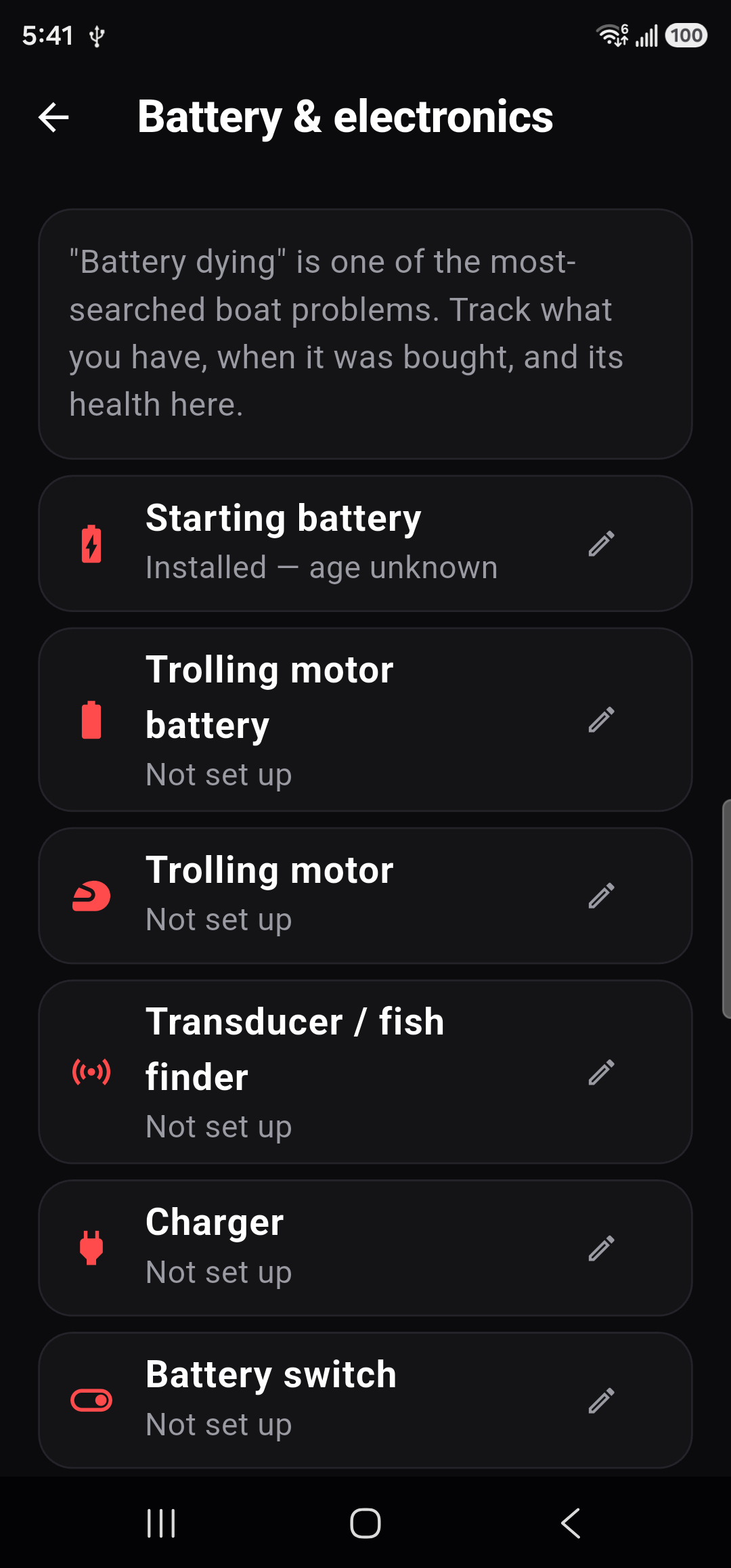
AftLog automatically tracks battery age, logs voltage readings, stores photos of terminal condition, reminds you to charge after trips, provides off-season storage checklists, notes symptoms of battery failure, and helps diagnose electrical issues.
Checklist: Battery Care
- Charge after every outing
- Keep voltage above 12.4V
- Inspect terminals monthly
- Clean corrosion immediately
- Use a smart charger
- Store fully charged
- Disconnect terminals for winter
- Check voltage monthly during storage
- Log battery age in AftLog
Summary
Boat batteries are simple, but they require consistent care. Charging properly, storing correctly, and inspecting regularly will dramatically extend battery life and prevent off-season failure. Whether you use lead-acid, AGM, or lithium, following these steps ensures your boat starts strong every time.
AftLog tracks battery health automatically — so you're never caught off guard.
Track these on your boat with AftLog — free to start, $29 lifetime Pro.